Eyes
Brow Lift
Repositions a low or descended brow back to a more anatomically appropriate height. Often performed with eyelid surgery to address the upper-face as a whole.

Overview
A brow lift repositions a descended brow back to a higher, more anatomically appropriate position. It also smooths horizontal forehead lines that develop when the muscles work to elevate a low brow. Several techniques exist — endoscopic, hairline (pretrichial), and direct — and the choice depends on the patient's hairline, forehead height, and the degree of correction needed. Brow lift is often performed in combination with eyelid surgery: lifting the brow without addressing the upper eyelid, or vice versa, can leave an imbalanced result.
Who it's for
The right candidate.
Patients with a low or descended brow position, deep horizontal forehead lines, or heaviness above the upper eyelid that does not resolve with blepharoplasty alone. Often performed in combination with eyelid surgery.
Technique
How it's done.
Several approaches exist. Endoscopic brow lift uses small incisions hidden in the hairline; hairline (pretrichial) lift uses an incision along the frontal hairline; direct or temporal lifts use limited incisions for targeted corrections. The choice depends on hairline position, forehead height, and the degree of correction needed.
Where this happens
Our own surgery center.
One roof, one team.
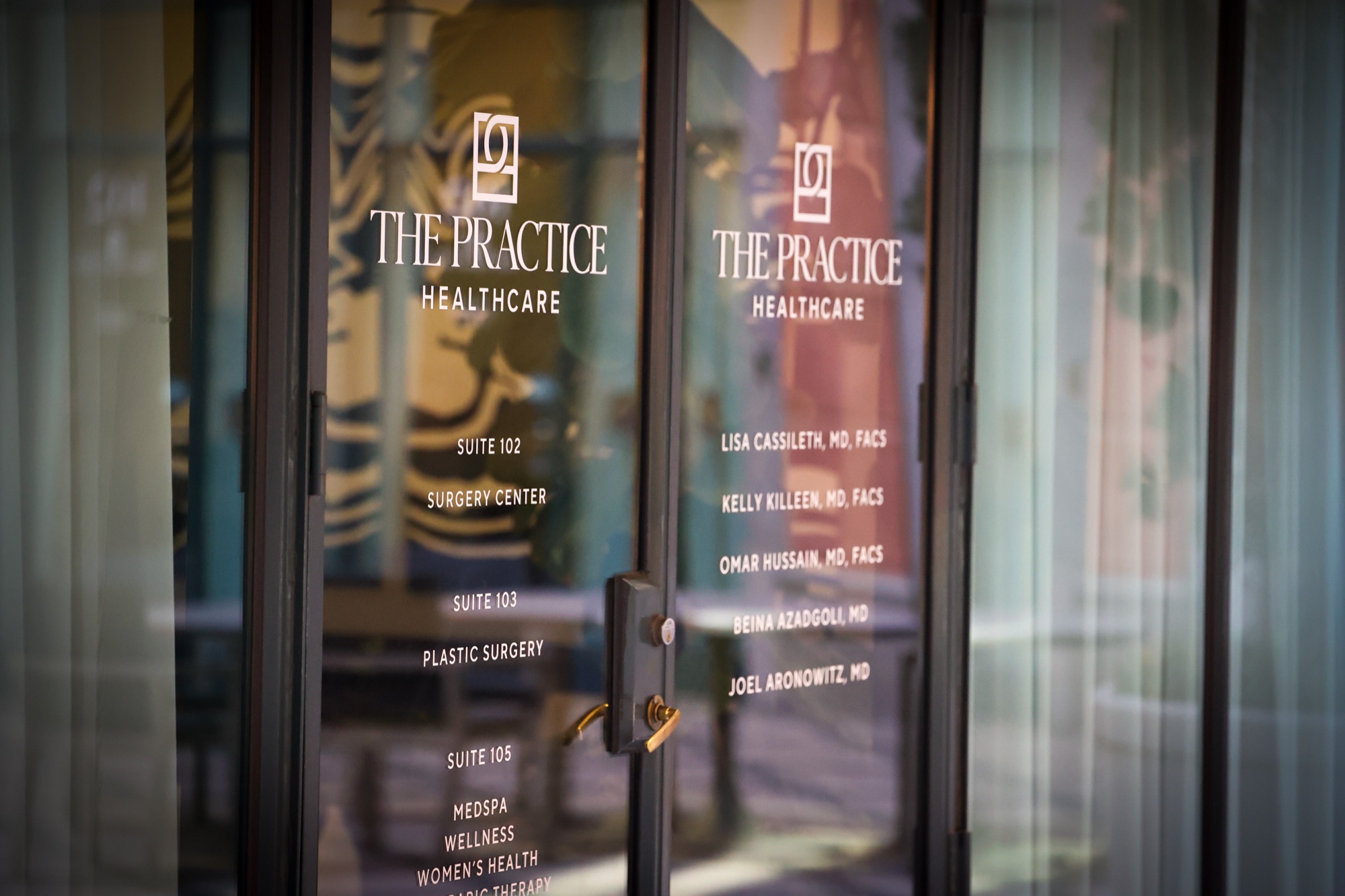
Dr. Azadgoli operates at The Practice Healthcare's fully independent, on-property ambulatory surgery center — a Medicare-certified, physician-led facility recognized by Newsweek as one of California's top centers for independent, privately owned surgery.
Consultation, surgery, aftercare, and recovery all happen in one building, with the same team. No outside hospital. No new staff to meet the day of surgery. The same person who checked you in at the consult is there when you wake up.
What to expect
From consultation to recovery.
Outpatient under general anesthesia. Numbness in the scalp for several weeks is normal. Most patients are back to work and social activity at one to two weeks; final settling over three to six months.

Insurance & coverage
Patient Advocacy handles the paperwork.
Our advocacy team verifies benefits, pursues pre-authorizations, and appeals denials. You don't navigate insurance on your own.
Cosmetic procedures are generally not covered by insurance. For reconstructive or medically necessary work, our advocacy team verifies your benefits and presents the out-of-pocket estimate before anything is scheduled.
How we work with insurance
- 1 Verification by expertsOur advocacy team verifies your benefits before any procedure — so we know exactly what is and is not covered.
- 2 Patient advocacy & follow-throughWe aggressively pursue pre-authorizations, appeal denials when appropriate, and hold carriers accountable to their commitments.
- 3 Financial transparencyYou receive a clear written estimate of potential out-of-pocket costs. No surprises on the day of surgery.
- 4 Collaboration with carriersOur team handles documentation and communication directly with your insurance company.
- 5 Options & supportIf a procedure is not covered, we walk you through cash-pay options, financing, and other pathways to care.
FAQ
Common questions.
Will my forehead look frozen?
No. The brow is repositioned but normal expression remains. The result should be a more rested look, not a fixed one.
How is this different from Botox?
Botox temporarily relaxes the muscles that pull the brow down. Brow lift surgically repositions the brow. Botox is reversible and short-term; surgery is durable. They address different patients.
Will my hairline change?
It depends on technique. Endoscopic lifts do not lower the hairline. Pretrichial lifts can lower the hairline slightly. Hair growth through the incision is typical with careful technique.
How is the result different from Botox?
Botox temporarily relaxes the muscles that pull the brow down. A brow lift surgically repositions the brow itself. Botox is reversible and short-term; surgery is durable. Different patients are appropriate for each.
Will I have a scar?
Depends on technique. Endoscopic lifts use small incisions hidden in the hairline. Pretrichial lifts use an incision along the front hairline that allows hair to grow through it. Direct brow lifts use a short scar just above the brow, used in select cases.
Will I still have forehead motion?
Yes. The frontalis muscle that elevates the brow is preserved; horizontal forehead lines that come from over-using that muscle to compensate for a low brow tend to soften because the muscle no longer needs to work as hard.
Ready to discuss brow lift?
Schedule a consultation with Dr. Azadgoli and her team to explore your options.
Request a consultation